 Estfor kingdom
 connects skill training, combat, and item trading
Estfor kingdom is an idle role-playing game where heroes train skills, gather resources, fight monsters, and craft items. Players schedule activities rather than control every movement, and blockchain transactions record changes to their characters and possessions. Skills determine access to activities, while equipment and materials support those activities. Trading connects players who produce different goods. Quests, pets, and clans add objectives and combat options beyond a hero's ordinary training.
Last updatedQueue training with the required equipment
A hero needs the relevant skills, tools, and resources before an activity can contribute to progression. The ordinary action queue schedules training over time. Gathering, production, and combat belong to that system, although their inputs and rewards differ. Experience points, usually shortened to XP, track training progress; inventory balances track the items that activities consume or produce. A queued activity describes intended work. Recorded XP and item changes show the work that the game has processed.
Idle play therefore involves both scheduling and collecting results. Time allocation matters because activities share the ordinary queue, while material requirements determine what the hero can accomplish. The game also distinguishes ordinary queued actions from instant actions and a separate, longer passive queue. Those categories have different timing rules, so the word “idle” does not describe every operation identically.
What determines which activities a hero can perform?
The chosen activity's level and tool requirements determine whether a hero can perform it. Training earns XP and raises skill levels, which opens further actions. Owning a useful tool does not remove its associated training requirement. Equally, reaching a level does not supply the equipment or materials that an action needs.
Progression can involve several related skills. Gathering supplies resources, and production skills turn materials into other items. A hero pursuing that production chain may need to develop several skills or obtain goods from another player. These approaches answer different needs: training develops the character, while acquiring an item supplies a missing possession.
A higher skill level changes access to an action
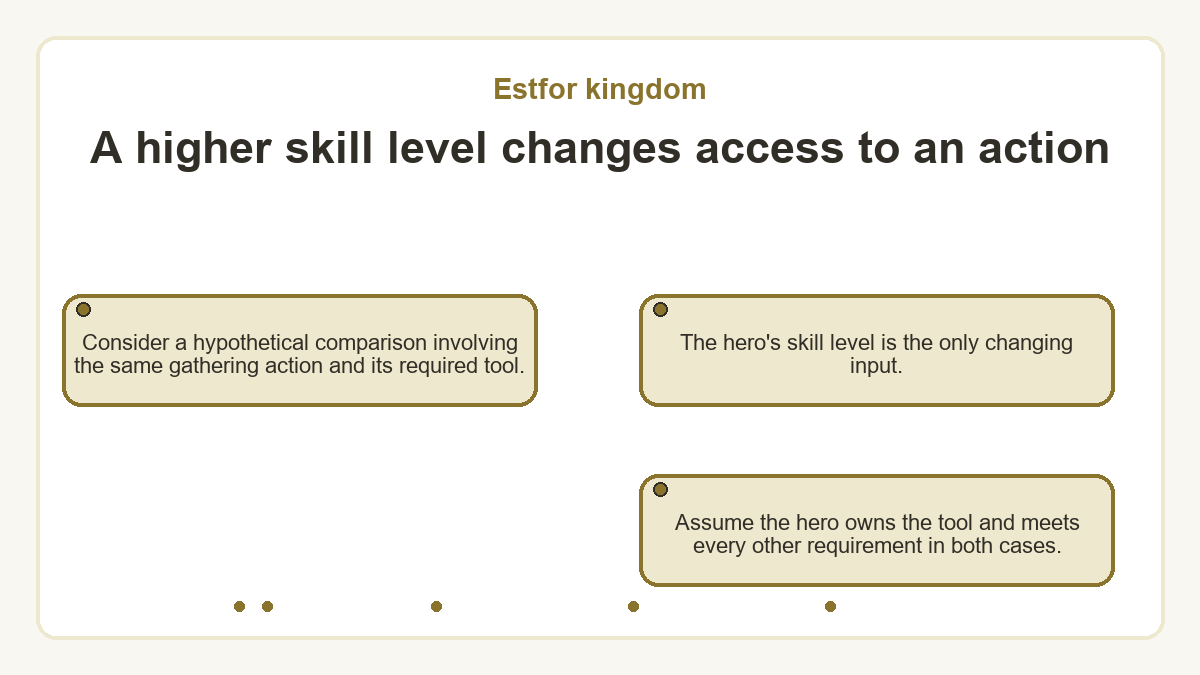
Consider a hypothetical comparison involving the same gathering action and its required tool. The hero's skill level is the only changing input. Assume the hero owns the tool and meets every other requirement in both cases.
In the first case, the hero's recorded skill level falls below the action's requirement. Owning the tool leaves that requirement unmet, so the action remains unavailable.
In the second case, the hero has earned enough XP to meet the required level. The equipment stays the same, but the level restriction no longer prevents the hero from selecting that action. This comparison concerns access, not a promised increase in resource output.
Before scheduling the newly available activity, the player checks the recorded level against its requirement and confirms the tool remains available. Receiving its resources still requires completing and processing the activity.
Gathering and production give items different uses
Resource gathering increases the stock of materials available for later activities, while crafting and smithing produce items through their own requirements. Training can advance a skill and supply goods at the same time; producing an item can consume materials that another activity generated.
Woodcutting, fishing, mining, smithing, and crafting are established parts of the game. Their relationships create a choice between producing goods and acquiring them through trade. Producing goods includes the associated training activity. Trading can supply an item without performing its production activity, but the purchase does not itself train that skill. The relevant comparison is what the player needs next: experience, materials, or a finished item.
Combat brings equipment and monster weaknesses together
Combat decisions depend on the hero's abilities and the monster's characteristics. Physical, ranged, and magical combat provide different approaches, and monster weaknesses make the choice relevant. Combat training develops the character, while equipment and pets contribute to the available fighting setup.
Loot gives combat a connection to the wider item economy. A reward may support another activity or become something another player wants. Its usefulness in combat and its attractiveness to a buyer are separate questions. Neither a character's progress nor an item's existence establishes what someone else will pay for it.
How does the item order book connect buyers and sellers?
Players specify an item, price, and quantity in their buy or sell orders. Estfor kingdom supports player-to-player item trading through an on-chain order book. This gives gathered resources and crafted goods a use beyond the inventory of the player who produced them.
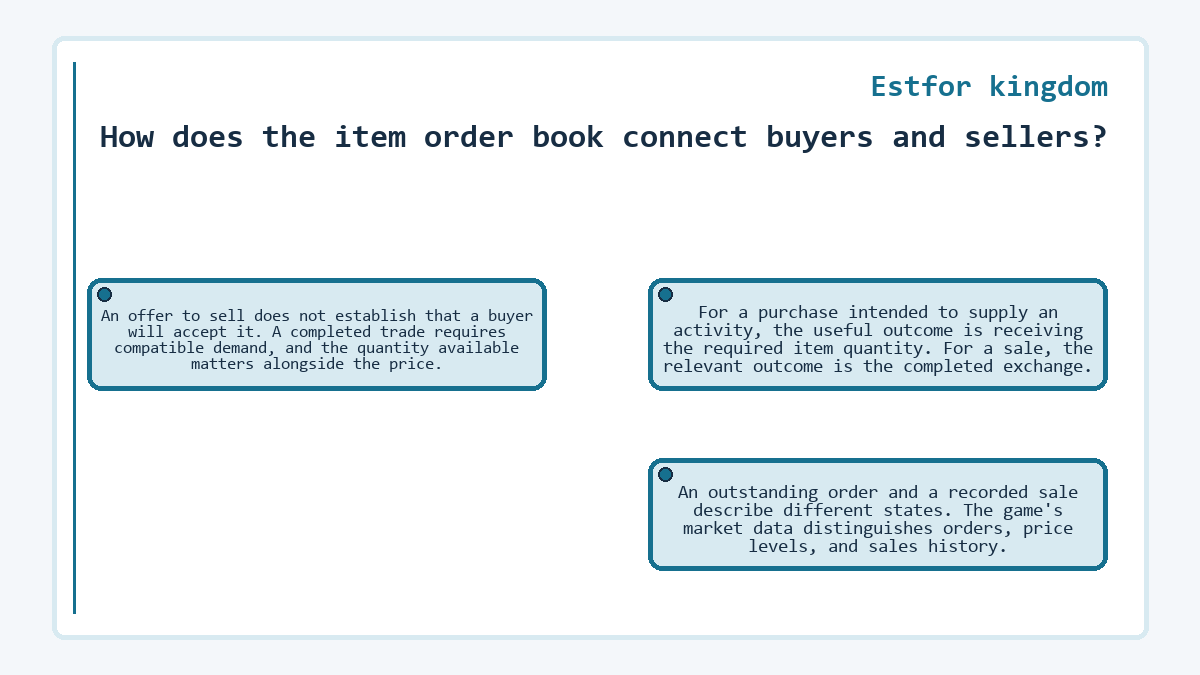
An offer to sell does not establish that a buyer will accept it. A completed trade requires compatible demand, and the quantity available matters alongside the price. For a purchase intended to supply an activity, the useful outcome is receiving the required item quantity. For a sale, the relevant outcome is the completed exchange. An outstanding order and a recorded sale describe different states. The game's market data distinguishes orders, price levels, and sales history.
BRUSH purchases and transaction costs serve different purposes
BRUSH is the in-game currency, with uses that include buying items, evolving heroes, and upgrading clans. An item purchase changes available possessions, while a hero or clan upgrade changes the corresponding game feature.
The cost of an item also differs from the cost of recording a blockchain transaction. Game spending can include purchases, upgrade charges, and trading fees; network execution adds a separate cost where the player pays gas. A free-to-play description does not make every optional purchase or transaction free. Exact expenditure depends on the chosen operation and its applicable charges, rather than a single universal entry price.
Pets add a separate path to combat bonuses
Egg incubation and hatching extend progression beyond ordinary skill training. Passive actions can run without preventing a hero from queuing ordinary daily actions. That separation allows egg development alongside the regular training schedule. Incubation uses ingredients to upgrade eggs, and hatching produces pets that contribute combat bonuses.
Pet species affect which combat skills receive bonuses, while the egg's tier influences their effectiveness. The appropriate comparison therefore starts with the combat skill that the pet supports. Collecting another pet and improving a particular combat setup are different objectives. Pets also have their own NFT collection and can be traded, providing an acquisition path alongside hatching. Neither path makes every pet equally suitable for every combat setup.
Quests and clans give training additional objectives
Quests attach requirements and rewards to particular objectives, giving ordinary activities another purpose. Their usefulness depends on what the hero can complete and what the objective awards. Quest progress and skill progress describe related but distinct achievements: a higher skill level does not automatically complete every quest.
Clans add shared resources and organized competition. Clan members can deposit items into a shared clan bank. Clan roles govern different abilities, and upgrades expand clan capabilities. Sharing possessions therefore involves both the available resources and the permissions attached to membership.
Clan wars introduce battles involving territories and vaults. These battles run separately from ordinary hero activities, so participation does not turn the regular training queue into a battle queue. Group objectives add another reason to develop heroes and coordinate resources.
The next choice follows the objective: train for an unavailable action, obtain materials for production, improve a combat setup, or contribute to a clan activity.
Estfor kingdom questions worth asking
-
Which blockchain does Estfor kingdom use?
- The game has its mainnet smart contracts on Sonic. Earlier versions ran on Fantom Opera, which explains why older launch descriptions name a different network. The Sonic deployment includes contracts for heroes, items, quests, clans, and other game systems.
-
Do I need to install a desktop game client?
- The game runs in a browser, so it does not require a separate desktop game client. Players still use account and transaction tools to interact with the game's blockchain contracts.
-
What does NFT ownership mean for game items?
- NFT ownership records possession of a game asset on the blockchain. The game represents heroes and items through token collections, allowing supported transfers and trading. Ownership of an item does not establish its market value or remove the requirements for using it.
-
Why can random loot require separate processing?
- An activity can finish before the random values needed to calculate its loot become available. Its random loot can therefore require later processing. The game also distinguishes ordinary action-loot randomness from the randomness used by instant VRF actions.
-
Are a hero's activities private?
- Game activity and ownership information are publicly queryable through the game's data services. Available records include hero details, activity journals, item holdings, and sales history. A character name therefore does not make the associated game records private.
-
Does hatching an egg always produce the same pet bonuses?
- Pet bonuses depend on the pet species and the egg's properties. Each species supports a particular combat skill set, while egg tier affects the strength of those bonuses. Some special egg varieties also produce pets with different qualities.